

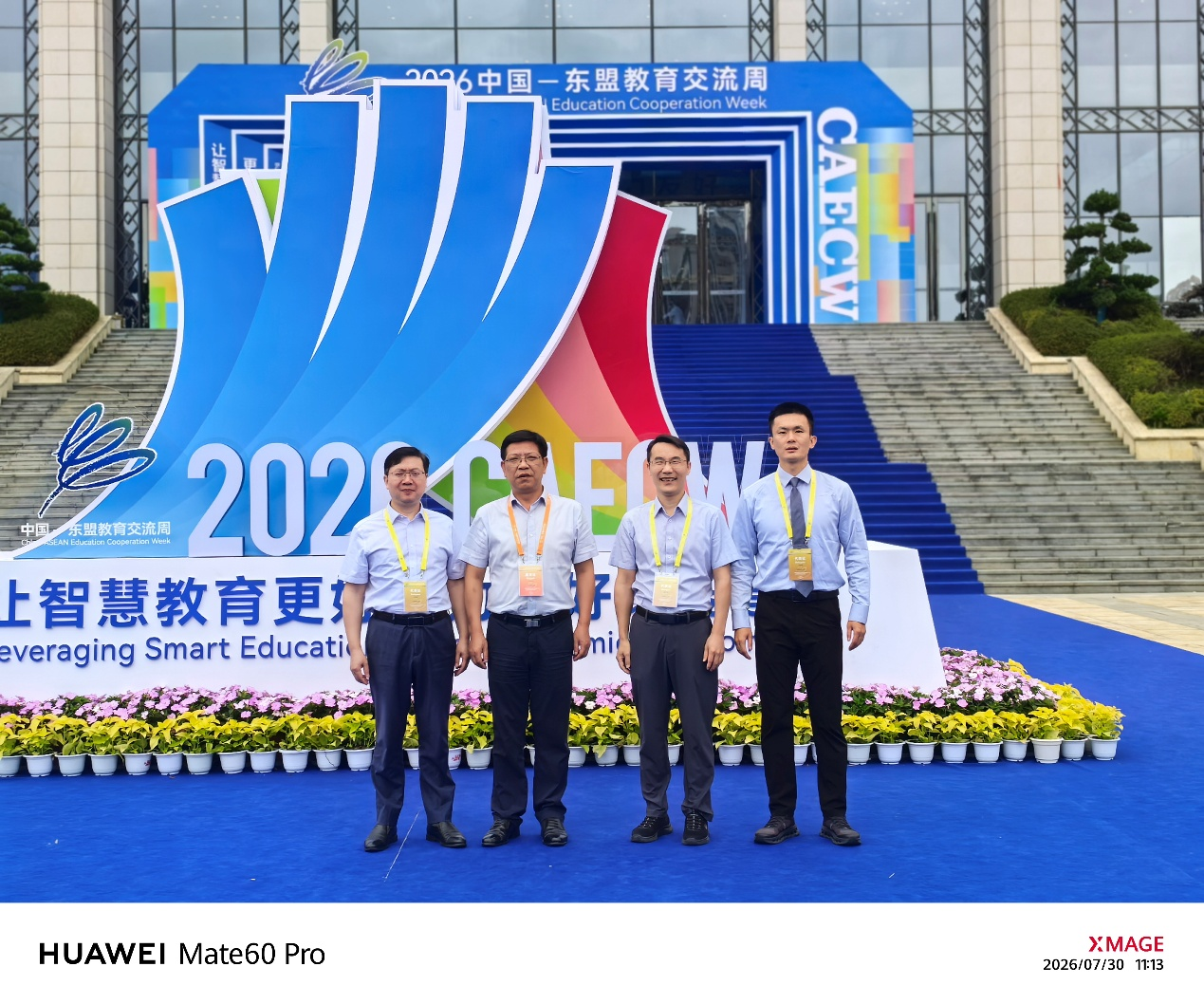
The 2026 China-ASEAN Education Exchange Week was held in Guiyang, Guizhou from July 28 to 30. Yuan Honglin, Vice President of JUFE, led a delegation to the event. Taking an active part in the Global South Development Forum, the team showcased JUFE’s achievements in developing digital and intelligent international education and its research on contemporary Chinese state power studies through keynote speeches, research outcome launches, roundtable discussions and academic matchmaking activities.
At the forum, Yuan Honglin delivered a keynote speech entitled From "Alignment" to "Integration": Exploration and Practice of High-level Internationalization of Higher Education in the Digital and Intelligent Era. He proposed that the internationalization of higher education in the new era should shift from aligning with international rules to proactively engaging in global dialogues. He elaborated on JUFE’s all-round international development framework of "2+3+X". Relying on three platforms including Sino-foreign cooperative education, disciplinary talent introduction and overseas campus programmes, JUFE has built the province’s first national Base for Disciplinary Innovation and Talent Introduction in Finance, Economics and Artificial Intelligence, launched an overseas master’s programme in Cambodia, developed international MOOC resources of "Chinese + Digital Finance and Economics", and formed a two-way collaborative pattern of "introduction — assimilation — innovation — export". Moving forward, the university will continue to explore approaches for AI-enabled finance and economics education, develop distinctive standards for international education, and contribute to the training of interdisciplinary finance and economics talents for ASEAN and the Global South.
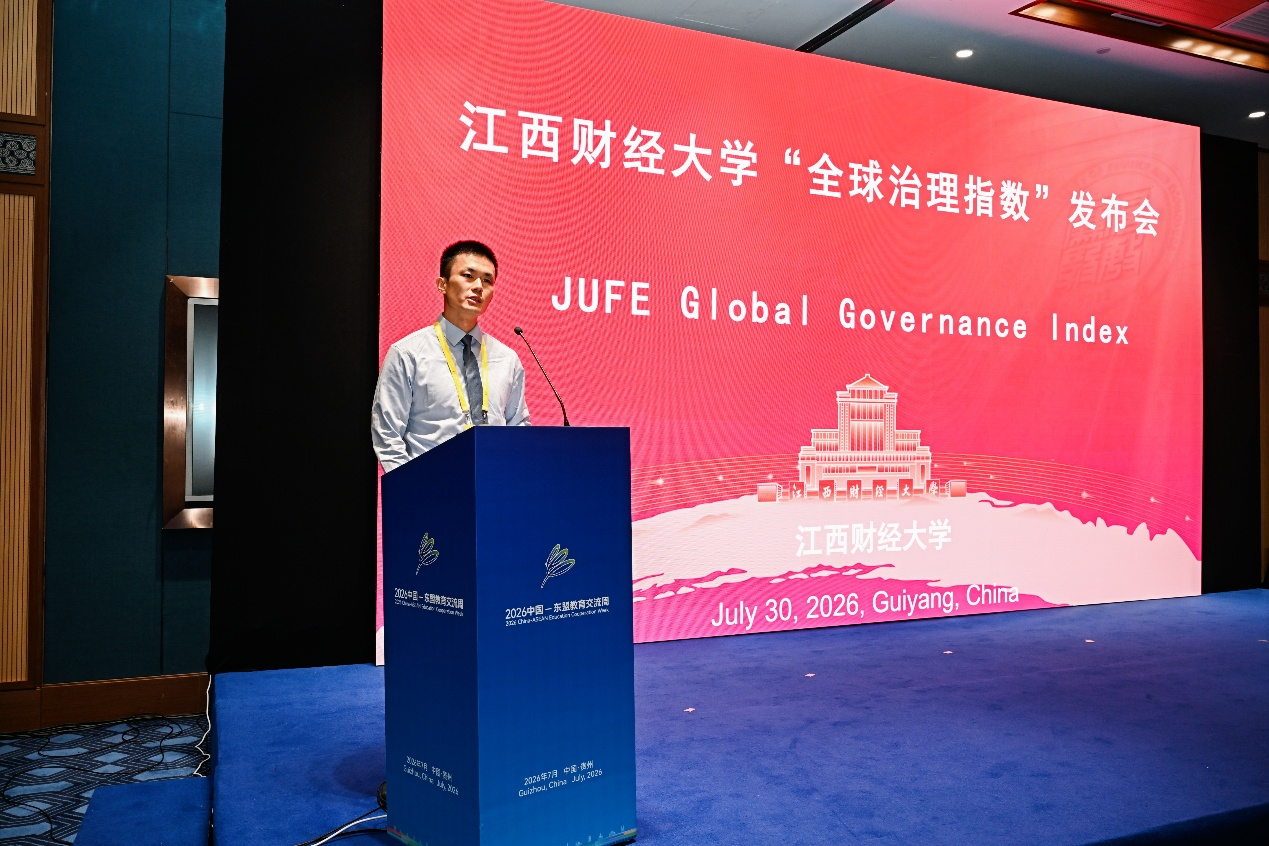
Feng Lingbing, Deputy Dean of the Institute of State Power Studies, unveiled JUFE’s original 2026 Global Governance Index (GGI) on site. Built upon the nation’s first research platform for state power studies and the State Power AI Intelligent Analysis System, the index is rooted in the five core tenets of the Global Governance Initiative. It establishes a quantitative evaluation framework consisting of 5 primary indicators, 13 secondary indicators and 65 tertiary indicators. The framework objectively measures the actual contributions of more than 190 countries worldwide to multilateral cooperation and the provision of global public goods, addressing the limitations of conventional Western governance indicators, which tend to focus on domestic affairs and carry value biases.The data shows that China performs prominently in multilateralism and the supply of global public goods, with its index growth rate ranking among the world’s highest. Following the launch of the research outcome, several ASEAN experts exchanged views on regional indicator optimization, data sharing and joint research, reaching intent for cooperation.
Gong Meijun, Director of the Office of International Cooperation and Exchange ,was invited to the roundtable discussion. He shared JUFE’s practices in jointly developing China-ASEAN digital education and the collaborative training of international finance and economics talents, and proposed building regular cooperation platforms such as online course sharing and exchange visits for young scholars. Wu Chaoyang, Dean of the Institute of Regional and Country Studies, actively engaged with experts and scholars from ASEAN universities and national think tanks to discuss cooperation on joint research covering ASEAN digital economy and regional governance.
This participation marks an important practice for JUFE to leverage its interdisciplinary strengths in finance, economics and state power studies, serve the country’s high-standard opening-up, and deepen people-to-people and think-tank exchanges between China and ASEAN. Moving forward, JUFE will continue to expand practical cooperation with ASEAN institutions, iteratively refine the Global Governance Index system tailored for the ASEAN region, and cultivate finance and economics professionals with global competencies. Through educational exchanges and regional and country studies, JUFE will contribute to building the China-ASEAN community with a shared future.